
On this page
Every few months someone declares software engineers finished. That fear is common among juniors, hiring managers, and engineers themselves. We don’t think the profession is disappearing. We think the engineer’s job is moving up a level, and the team around it is changing shape.
We’ve heard this story before
Thomas Majchrowski’s article, The 70-Year Illusion: Why AI Won’t Kill the Software Engineer, makes a point we agree with. Every new abstraction layer, from machine code to assembly, to Fortran, COBOL and C, to Java and .NET, came with two predictions: programming would become easy, and engineers would become unnecessary. Both were wrong. Cheaper software made demand explode, and engineers moved up the stack.
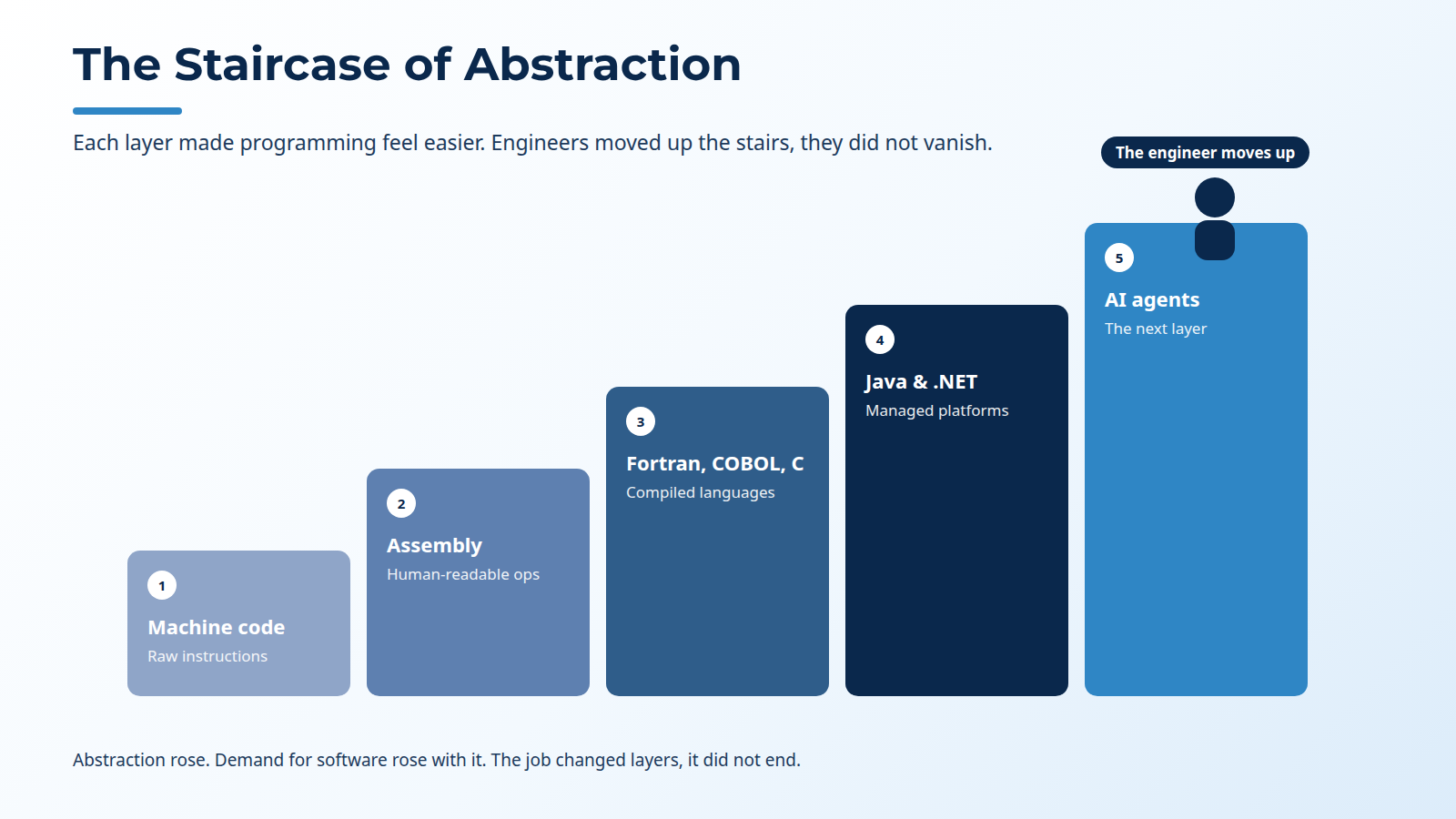
AI is the next step. It will take boilerplate and first drafts, and push the engineer’s value toward architecture, guardrails, data governance, and turning vague business problems into working systems. Where we would add to the story is the shape of the team.
The team changes shape
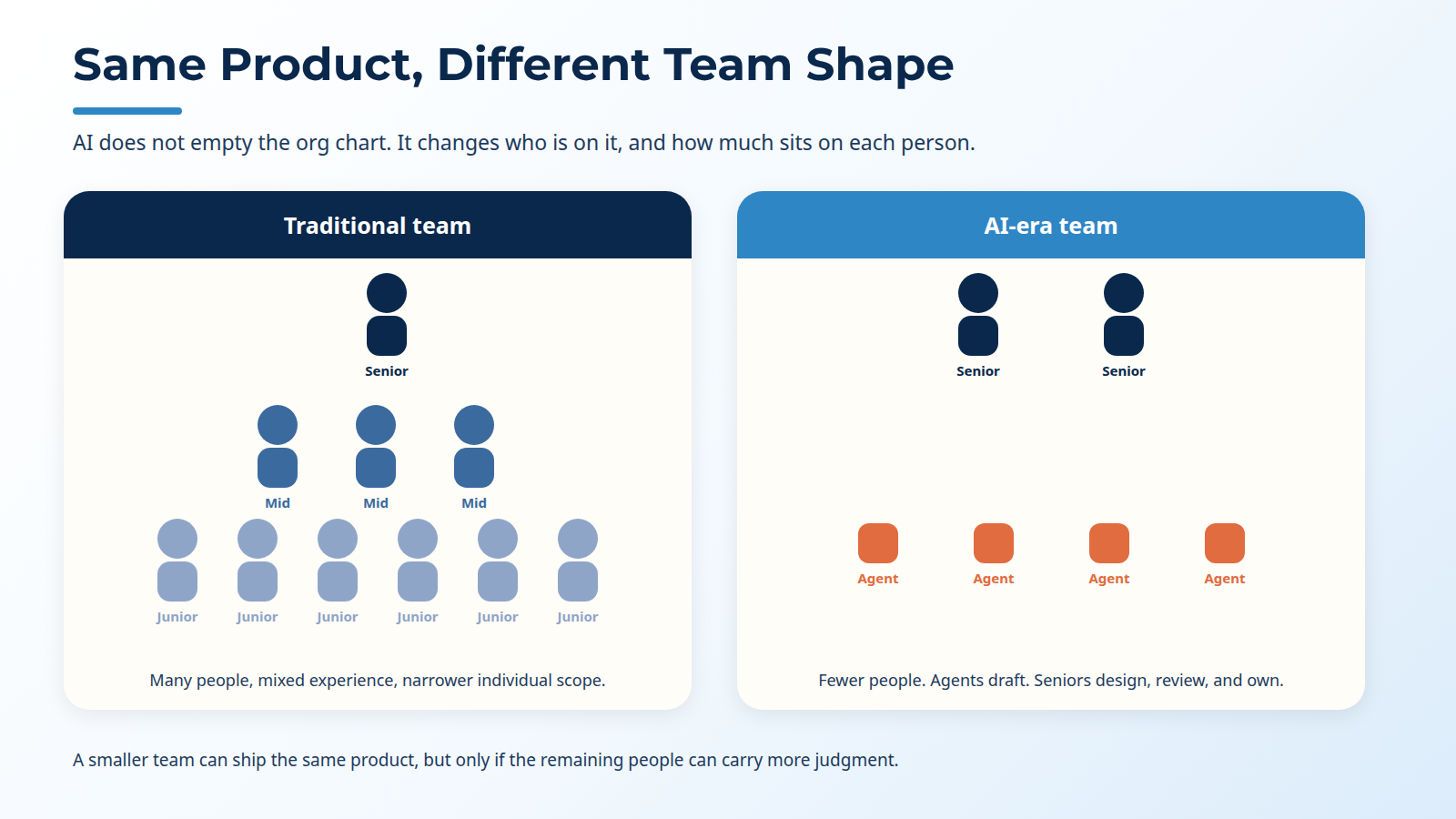
One senior engineer with a coding agent can now cover ground that used to need a small group. Companies will notice and staff fewer people per product, even while shipping more products. Engineers don’t disappear. Each one carries more responsibility, and agents do the first pass.
What the data says so far
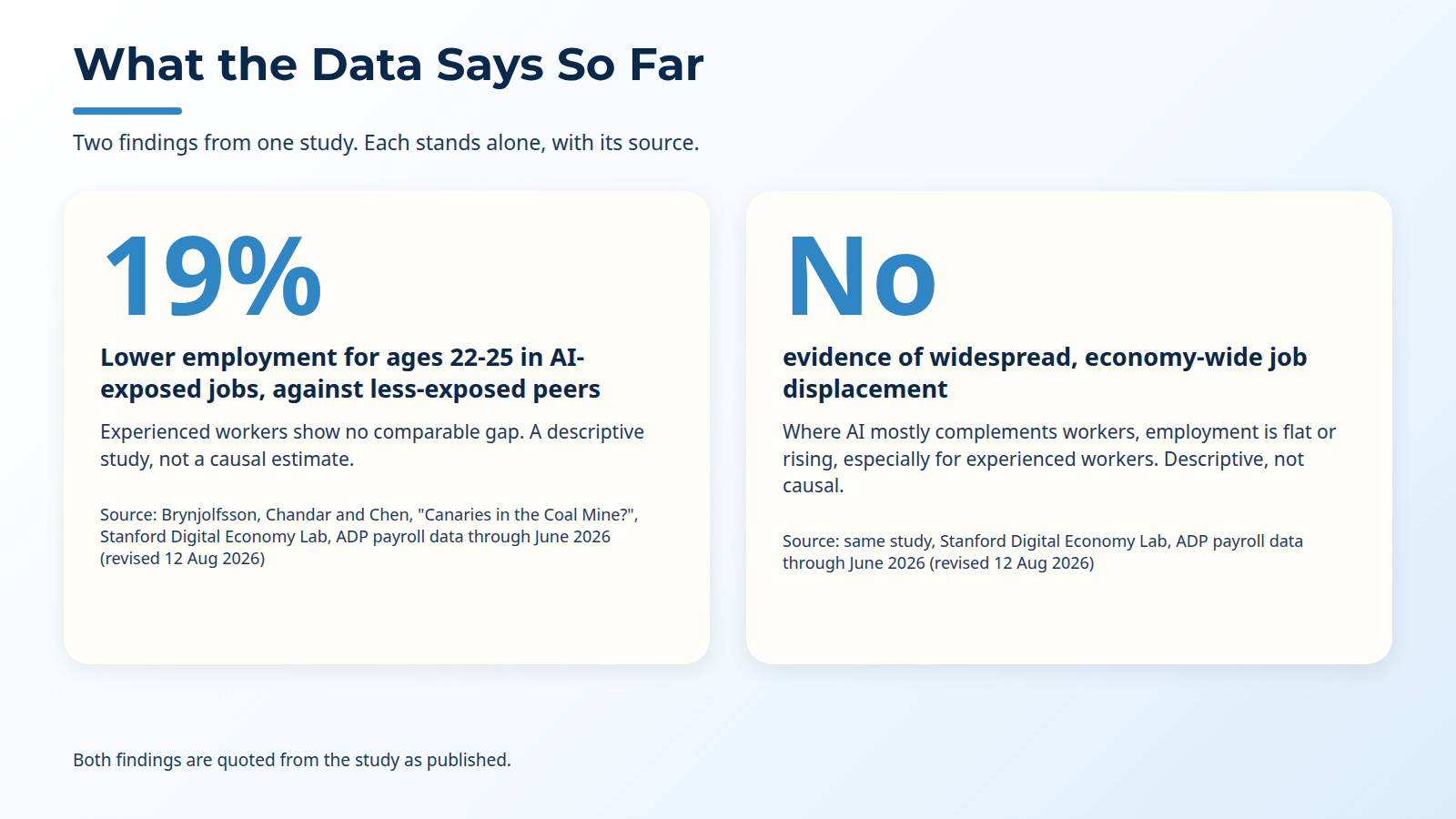
The best evidence we found is the Stanford Digital Economy Lab’s study of ADP payroll data through June 2026. It finds no evidence of widespread, economy-wide job displacement. It also finds that employment of workers aged 22 to 25 in AI-exposed occupations is 19% below where it would be had it kept pace with their less-exposed peers, while experienced workers show no comparable gap. Where AI mostly complements workers, employment is flat or rising, especially for experienced workers. The authors call these findings descriptive, not causal. They fit what we describe: the experienced engineer stays central, and the entry point is the part under strain.
What remains is senior work
The work that remains is senior work: deciding what to build, setting constraints, reviewing AI output, and owning failures in production. That is exactly what a coding agent cannot own for you.
The hidden risks
Juniors. Many engineers learned through bug fixes, tests, and small features. If agents take that work first, where do future seniors come from? A company that only hires seniors is borrowing from a training pipeline it no longer funds. Keep juniors in the loop, using agents but still explaining, testing, and defending the result.
Review. AI produces things that look finished but aren’t reliably right: hidden assumptions, security gaps, tests that prove nothing. If a team generates more code than it can honestly review, it isn’t moving faster. It’s deferring the problem.
Where AI-augmented teams fit
AI-augmented teams fit well-understood, small-scope work like internal tools, clear features, and pattern-based migrations. They fit less well when the problem is ambiguous, the system is critical, or a quiet mistake is expensive. Then you need strong people, their agents, and their review time, and later the junior bench you would have lost.
Generation is getting cheaper. Responsibility is not.
Closing
Building with AI probably means fewer engineers per product and more weight on experienced people. It does not mean the software engineer is finished. The job changes layers, as it has before.
To builders already shipping with coding agents: what has changed in your role, and what hasn’t?
Need an application built?
Ewarenow builds custom business applications. When off-the-shelf software can’t keep up, we build the application your business actually needs and connect it to the data and tools you already use. Whatever tools a team uses, the judgment, design and review behind the software is the part that matters. Tell us about your goals, your data, or the problem you’re trying to solve on our contact page, or read more about Customized Business Apps.
References
- Thomas Majchrowski, The 70-Year Illusion: Why AI Won’t Kill the Software Engineer, LinkedIn.
- Erik Brynjolfsson, Bharat Chandar and Ruyu Chen, Canaries in the Coal Mine? Six Facts about the Recent Employment Effects of Artificial Intelligence, Stanford Digital Economy Lab, ADP payroll data through June 2026, revised 12 August 2026. A descriptive study, not a causal estimate.

You May Also Like
Let’s start a conversation
No online order, no pressure - just a discussion about what your business needs.